Edwin Blake's research covers ICT for Development and Games and Virtual Environments
My research focuses on People and our relation to Computers. It looks at the the use of Information and Communications Technology (ICT) for socio-economic development, known as ICT4D. I have realized that the most important use of computer based systems is to empower people, that is, take a lead in running our lives according to our own priorities.
I am also interested more generally in User Experience (UX) of computing and interactive systems (like Virtual Environments (VE's) and Computer Game).
There are interesting areas of overlap between the fields and I think that my research would interest anyone who wants to develop insights and practical skills about how we can use computers effectively. On the whole I adopt the approach of building applicable systems and then reflecting on the implications: a method that is also known as Experimental Computer Science.
During 2013 I would particularly like to investigate the broad area of ICT4D and Empowerment, but I would encourage prospective masters and doctoral students who are interested in related topics within the general areas outlined above to discuss possibilities with me: a really passionate interest is important. WHile the NRF has stopped providing bursaries to researchers for their students some funding from a number of sources are available for these projects. In certain cases we can raise funds for students.
This project is funded by the Hasso Platner Institute, SA Commercial and SA Government funders. There is an exchnage programme for joint research with Namibia. It would involve site visits and possible travel to neighbouring countries to demonstrate replicability of the work.
Citizen Empowerment
South Africa has recently seen many service delivery protests. The aim of this project is to provide an effective channel for citizens to provide information to government on service delivery requirements and issues. There currently already examples of such services (for example, uReport run by UNICEF in cooperation with the government of Uganda). The aim of this project is to derive a system that will work in the South African context (e.g., SMS prices are much higher but data communication systems are common). The challenge will be to deliver a system that will run on the most common types of phones (not high end smart phones).
Factors that will have to be looked at will be how to integrate this with a feedback mechanism to ensure that people feel heard. Statistics and visualizations will be required to provide local authorities with usable information. In this way we can help to defuse the frustrations that have lead to violence in the past.
Rural Communication and Open Spectrum for Development
We have been involved in mesh networks (and associated technologies) for rural communication. We wish to create user friendly environments for this research that targets the needs of rural users. Such needs are related to supporting communication all communication needs which may be more than just meshed networks and can include support for GSM mobile phones, local content creation and content distribution.
The current regulatory environment obliges us to use the WiFi 2.4GHz and 5GHz bands. These are unsuitable to rural communication because of the short transmission ranges (these bands are better for heating up water in microwaves than they are for long distance signal transmission).
The project has two aims:
- Explore the application of current generation WiFi based meshed networks (e.g., Mesh Potato) in rural areas. Here we look at practical applications and how to integrate such systems in a community. The applications can include health care and other issues can include the provision of solar-based electric power.
- Build test-beds to evaluate the use of TV white space as soon as such spectrum becomes available for experimental use.
It is expected that much of the user experience and supporting technology will carry over from WiFi-based mesh networks to the next generation.
Methods for Software Design in Developing World Situations
How can we develop software for rural and disadvantaged communities? This research builds on previous work that set out to develop and deploy useful systems for these kinds of users. We build systems that will enable us to have a useful and sustainable impact.
This method must be interdisciplinary in nature (not just technologically based, as would be the bias of a Computer Scientist) and situated in the lived context of the community involved. Even the term ICT "for" Development is problematic since it should rather be ICT "with" Development. As ever the way to derive the method would be to develop ICT applications and content.
Communication Access for Deaf People

The aim of this project provide Deaf users with a practical way of communicating in their own language, South African Sign Language, and at the same time highlight policy impediments to the widespread adoption of such a solution. The key question is: Can camera equipped cell phones as well as handheld and personal computers be used to provide an effective low-cost and natural communication tool for Deaf people who use sign language? This project is being done in cooperation with the Bastion of the Deaf in Newlands, Cape Town, and with Deaf Community of Cape Town (DCCT) — a grassroots NGO run by Deaf people to serve the needs of the historically disadvantaged Deaf community in Cape Town as well as SLED (Sign Language Education and Development — www.sled.org.za).
Flow in Computer Games
How would we characterize a really engaging or enjoyable game? We already have a reasonable approach to measuring that sort of thing in Virtual Environments (see Presence below). A strict definition of Presence however attempts to ignore the contents of the experience: which is precisely what is central in a game! Building on the idea of an Optimal Experience or Flow Experience by Csikszentmihalyi we want to explore what a measure of "Presence + Content" would be in games.
We look in the first instance at the genre of Sandbox Games — games that have open-ended worlds, through which there is no one single, correct pathway. Sandbox games are known for their status as contexts for creative player expression, with multiple solution paths (their quality is judged according to their ability to deliver such an experience). Examples of such games include Civilization III, Grand Theft Auto series, Sim City, etc.
Presence and Virtual Environment Applications
Collaborative Virtual Environments (CVEs) provide new possibilities for communication and collaboration, with a lot of potential and enhancements for the way we work and exchange information. For such systems to be successful they must provide participants with a high sense of presence; giving them a sense of ‘being there’ in the place specified by the virtual environment rather than just seeing images in the lab.
We are interested in the extent that virtual environments can elicit real emotional responses from participants. We believe that this aim makes for an interesting “hard problem” on which to focus our ambitions. In this work you are likely to build a CVE and then evaluate its effectiveness. You may also try to advance the theory of Presence in terms of underlying causes or in terms of measurement techniques.
A particular application of interest is the use of VE for HIV/AIDS support and storytelling (see below).
Authoring and Design of Computer Games and Virtual Environments
I am interested in the design issues raised by Multi-Player Mobile Games, especially in using good design to overcome limitations such as latency and small screen size. More generally we have worked on designing interactive Games and VEs. We have already developed some successful ways of tacking this problem but there is scope for additional research on paradigms for supporting artists and graphic designers in this task. This project can range form addressing quite technical issues in terms of programming paradigms to more user orientated research.
Use of Realism
A reflection on the use of realism in games and virtual reality. This is particularly relevant because our work focuses on the role of content and on low-cost solutions. Both aspects call into question the need for perceptual realism as the primary focus of a Virtual Reality experience. We will consider the degree to which notions of realism evolve (so that what was perceived as realistic at one time becomes crude and artificial later on) and the extent to which an experience is labelled realistic depends on the extent of user presence independent of objective measures of perceptual fidelity to reality.
Cultural Heritage
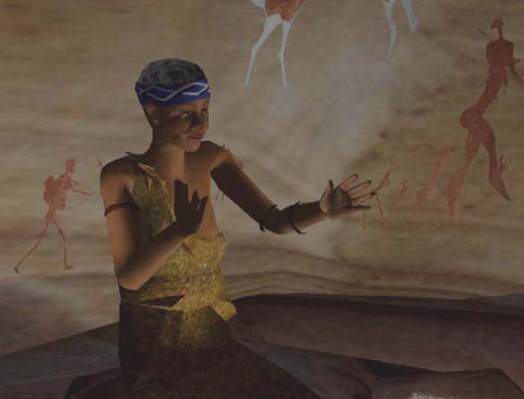
Develop specific applications of Virtual Environments in Cultural Heritage and develop virtual museum exhibitions and other application of VR technology for education and entertainment. Museums need the capability of conceiving and developing virtual exhibitions themselves to have creative control and reduce costs. Furthermore digital content can be easily be broadcast to other museums and countries for the appreciation by a wider audience.
The aim is to produce effective low-cost tools for exhibition and conservation of cultural heritage. Lowering costs allow museums to own the tools and creative control. The virtual tools will complement South Africa's oral tradition in passing on history. A rich museum experience will increase awareness and reflection on South African Culture in its living context. The local community will be able contribute and value their cultural heritage. In the long term this should ensure its preservation.
HIV/AIDS Support
Develop the HIV/AIDS support environment. The current environment is designed to provide information support to people living with HIV. It provides information on coping strategies and diet. The environment is designed for extension and an interesting research issue is related to the ability of VE's to change people's sexual behaviour (particularly risky behaviour).