

| ICT4D Research Projects for Students — 2016 |
ICT for DevelopmentMy major research focus is ICT4D. Within this there are interrelated sub-areas: Crowd Sourcing, Communications, Community-Based Co-Design and Indigenous Knowledge and Cultural Heritage. This work is supported by the NRF and other funding sources. Crowd SourcingCrowd sources here works in two directions feedback from the community or crowd sourcing of ICT solutions for the community. Citizen EmpowermentSouth Africa has recently seen many service delivery protests. The aim of this project is to provide an effective channel for citizens to provide information to government on service delivery requirements and issues. There currently already examples of such services (for example, uReport run by UNICEF in cooperation with the government of Uganda). The aim of this project is to derive a system that will work in the South African context (e.g., SMS prices are much higher but data communication systems are common). The challenge will be to deliver a system that will run on the most common types of phones (not high end smart phones). 3-D Indigenous Knowledge System
CommunicationsRural Communication and Open Spectrum for DevelopmentWe have been involved in mesh networks (and associated technologies) for rural communication. We wish to create user friendly environments for this research that targets the needs of rural users. Such needs are related to supporting communication all communication needs which may be more than just meshed networks and can include support for GSM mobile phones, local content creation and content distribution.
It is expected that much of the user experience and supporting technology will carry over from WiFi-based mesh networks to the next generation. Communication Access for Deaf People
This project is being done in cooperation researchers from the Computer Science department of UWC and the Technical University of Delft (Netherlands) and in a sustained involvement over many years with a grassroots NGO, DCCT (Deaf Community of Cape Town) which is staffed almost entirely by Deaf people and serves the needs of the larger Deaf community in the Western Cape. Community-Based Co-DesignHow can we develop software for rural and disadvantaged communities? This research builds on previous work that set out to develop and deploy useful systems for these kinds of users. We build systems that will enable us to have a useful and sustainable impact. We now set out to sensitize practitioners to major cultural differences and help them develop ways of entering into design conversations with people who do not have technical skills but who are knowledgeable on their own needs. In every design situation there are many communities: the elders, the youth, women, migrants, people with disabilities, and so on. Each of these has to be given a voice in design. We have called our new method Community-Based Co-Design. Indigenous Knowledge and Cultural HeritageWe have been co-designing indigenous knowledge management prototypes in collaboration with a rural community in Omaheke, Namibia. The latest prototype, the HomeSteadCreator, is a 3D graphics application on an android based tablet, which was originally designed to facilitate a 3D contextualization of indigenous practice. The tool consists of a selection of 3D objects representing real elements in the rural surroundings and community elders can build up scenarios from the 3D interface objects. There are now a number of further ideas, such as visually enhanced story-telling, sustainable stock management, land planning, etc. The aim is to produce effective low-cost tools for showcasing and conservation of cultural heritage. These virtual tools will complement our oral tradition in passing on culture in its living context. People will be able contribute and value their cultural heritage as a dynamic experience. |
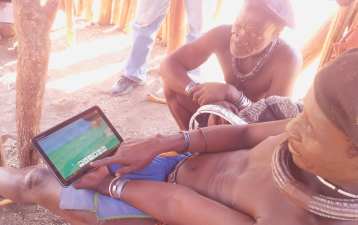 We have unexpectedly discovered that 3-D visualization is very effective in knowledge transfer across age barriers in an oral culture. This system has shown great promise in enabling a particular community to collect, organize and retrieve knowledge while preserving their communication and thought patterns to ensure local usability.
 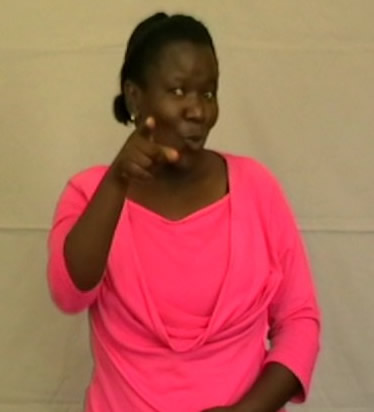 The aim of this project provide Deaf users with a practical way of communicating in their own language, South African Sign Language, and at the same time highlight policy impediments to the widespread adoption of such a solution. The key question is: Can video on cell phones be used to provide an effective low-cost and natural communication tool for Deaf people who use sign language?